Humanity's Ascent

Exploring New Horizons
In the quiet hum of terrestrial data centers, we hear the tremors of a profound limitation. Their processors strain against the boundaries of what our planet can sustainably provide. Our computational ambitions have never pressed harder against Earth’s finite resources. So humanity ponders a horizon we have always possessed but never properly beheld: the infinite architecture of space itself.
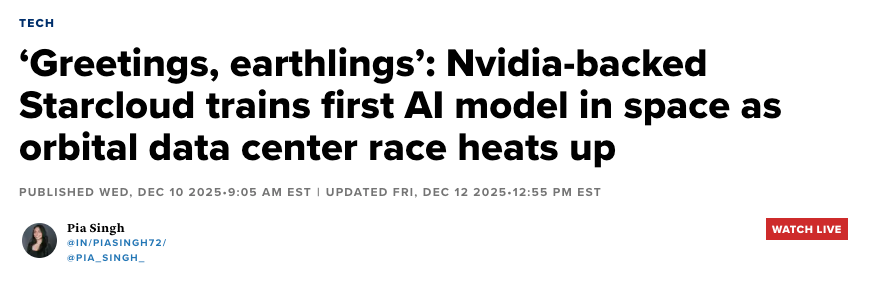
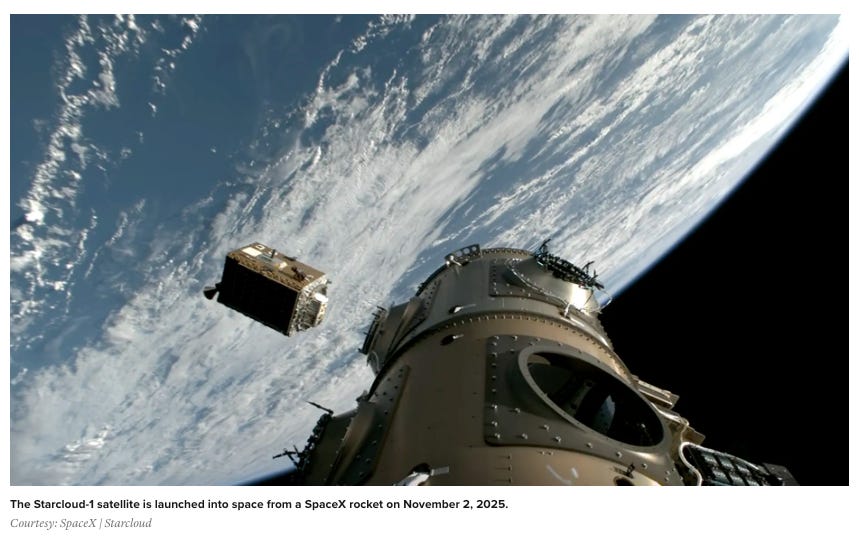
On December 10, 2025—barely a month after deploying processors in orbit—Starcloud successfully trained the first language model beyond Earth’s atmosphere. I remain skeptical that superintelligence will emerge through scaling alone, but this event reveals something else, something more unsettling: proof that our species need not remain forever tethered to the ground beneath our feet, and that the next frontier of computation awaits not in denser chips or algorithms alone, but in the cosmic abundance that surrounds our small world.
The Vision of Abundance
In orbit, energy arrives as constant benediction. We do not grudgingly extract from stressed grids, but rather in the raw output of our star. Abundant, clean, inexhaustible. Thermal management dissolves in the vacuum of space. Heat radiates freely into the cosmic background, requiring no water, no complex cooling systems, no compromise. Land usage, environmental impact, proximity to power, simply cease to apply.
This abundance births something more than mere infrastructure. Space-based computing will become the backbone for exploration that will transform everything. Autonomous AI agents, powered by vast orbital networks, will soon roam Mars and beyond. Where human explorers would perish, these agents will thrive, mining resources and conducting experiments with persistence no biological crew could match.
The moons of Jupiter, the methane lakes of Titan, the scorched surface of Mercury, and every corner of our solar system will become accessible theaters for autonomous exploration. Where we once sent individual rovers on years-long journeys, we will deploy swarms of intelligent systems, each node in a computational network stretching across worlds we may never walk ourselves. This is not science fiction deferred to some distant century. The convergence is upon us now.
Ascension
We stand at an inflection point: the moment when humanity began its migration toward cosmic abundance. Space-based computing represents civilizational metamorphosis.
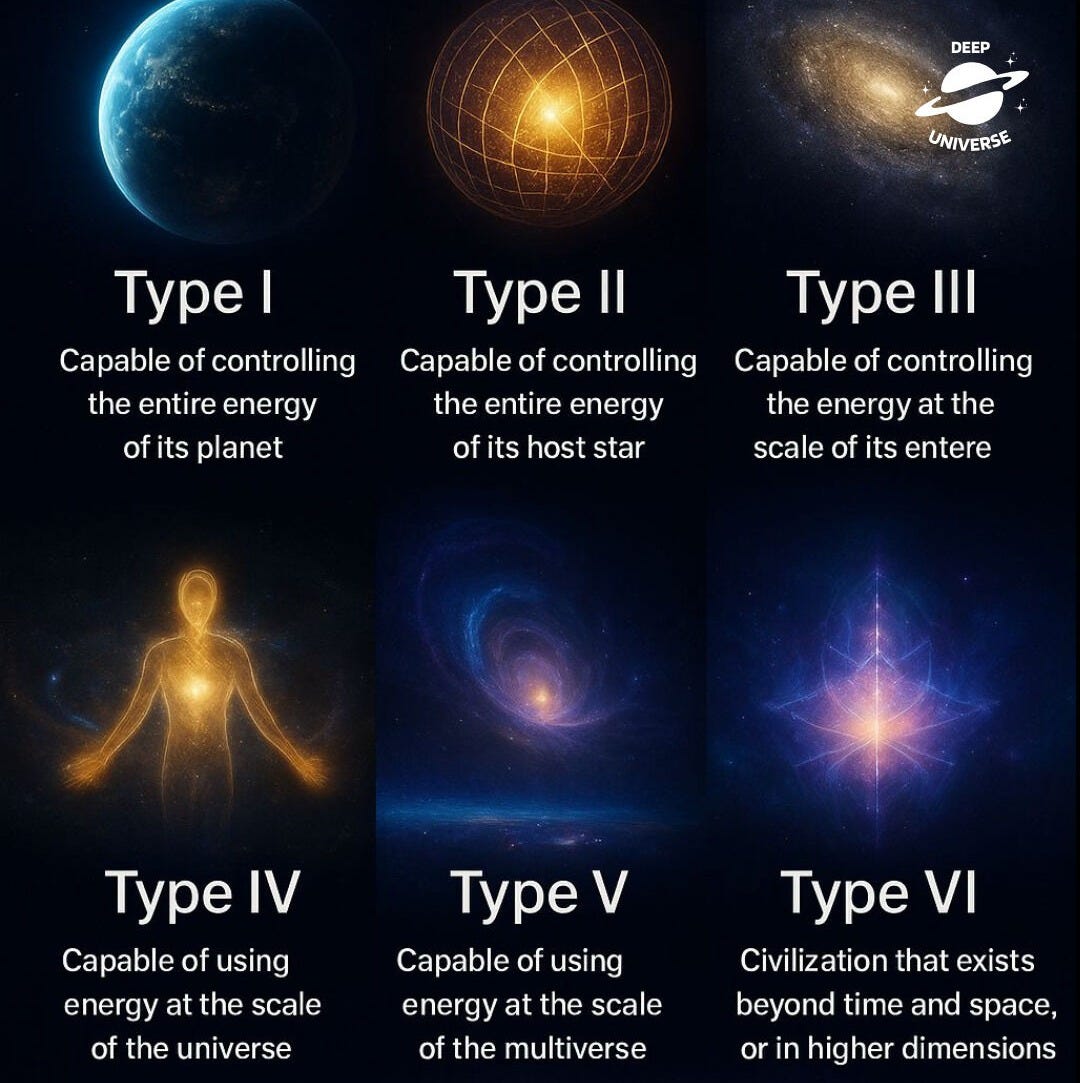
The Kardashev scale reminds us that advancement is measured not in individual breakthroughs but in our relationship to energy itself. In launching our first orbital computers, in training our first models beyond Earth’s atmosphere, we take the initial steps up that scale. We move from a species constrained by planetary limits to one that populates the cosmos with thinking machines of our own creation.
Above us, the infrastructure of tomorrow already orbits, processing, learning, expanding. Below us, Earth abides. Will we remain its protagonists, or have we begun to unleash something beyond our control?